
九品芝麻官
China to accelerate AI, robot use in high-risk coal mines_我的网站

A |
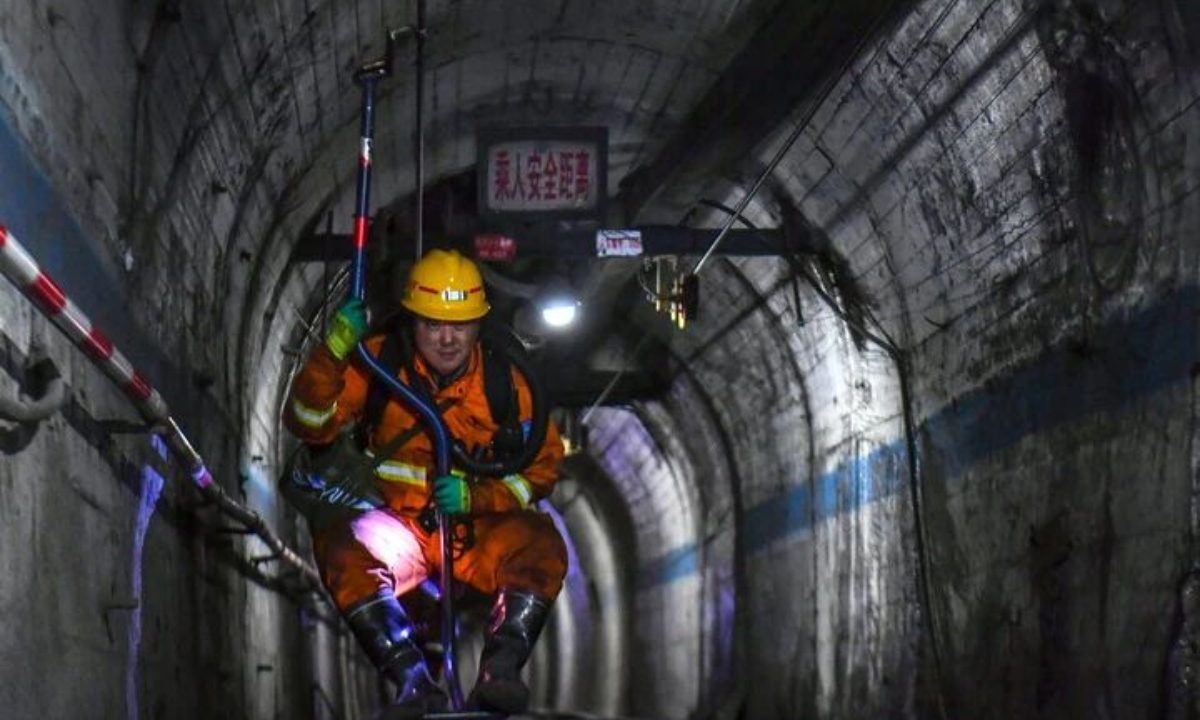
China is stepping up the intelligent transformation of its high-risk coal mines, as the country's top economic planner and energy regulator rolled out a new development plan during the 15th Five-Year Plan (2026-30) period that calls for greater use of artificial intelligence (AI) and robots in hazardous underground operations.
The National Development and Reform Commission and the National Energy Administration (NEA) on Monday announced a plan that emphasizes the need to strengthen coal's role as a foundational and balancing pillar in China's energy supply system while accelerating high-quality development in the sector, according to the NEA's website.
According to the plan, China will deepen its "AI Plus" initiative in the coal industry by collecting and integrating AI-related data and expanding the use of AI across key scenarios such as exploration and design, construction and production, operation and maintenance, and safety management.
The plan also calls for faster development of specialized large-language AI models for the coal sector, with breakthroughs needed in intelligent perception, autonomous decision-making and intelligent control. It also emphasizes the need to establish a number of pilot coal mines for the integrated application of AI, and improvements in coal mine safety.
The plan specifically targets intelligent upgrades at disaster-prone mines and those that have experienced major accidents, pushing for robotic substitution at hazardous posts, according to the document.
Industry observers said that the move signals a shift in China's coal mine automation efforts from pilot projects to large-scale deployment. High-risk tasks such as tunneling, inspection, rescue, roof support and blasting are emerging as priority areas for substitution by robots.
Hangzhou-based DEEP Robotics has been focusing on the use of quadruped robots for mine inspections and emergency rescue. In May, the company worked with the Zhejiang Provincial Emergency Management Department and other agencies to unveil its embodied intelligent equipment and conducted a live reconnaissance and rescue drill in a mine tunnel in Changshan, East China's Zhejiang Province, the company told the Global Times on Monday.
Using DEEP Robotics' Lynx M20 wheeled-legged robot as its mobile platform, it innovatively integrates large-language models and an onboard platform, and is equipped with a dual-spectrum pod, 5G module, edge computing unit, and other equipment.
Meanwhile, Lingbao CASBOT has formed a joint venture, to focus on the research and application of embodied intelligence robots for underground mining, according to the Beijing Daily. The company has since become involved in key processes such as rock drilling, blasting charge loading and support installation.
Such AI-powered equipment could significantly improve mine disaster warning and emergency response capabilities, helping mines transition to "less-manned" and "unmanned" operations and reducing human workers' exposure to danger, Lin Boqiang, director of the China Center for Energy Economics Research at Xiamen University, told the Global Times on Monday.
Lin said that robots have a clear advantage in dangerous tasks such as patrol inspections in 50 C deep shafts, gas leak detection, and heavy lifting. "For robots, these are exactly the jobs they should be taking on," he said.
Market research firm Zhiyan Consulting estimated that the market for mining robots grew to 2.85 billion yuan ($42.24 million) in 2025.
。 本文来自微信公众号:财联社 (ID:cailianpress),作者:黄君芝 包括苹果联合创始人史蒂夫·沃茲尼克(Steve Wozniak)和维珍集团董事长理查·布兰森(Richard Branson)在内的800多名知名人士,近日签署了一份公开声明,要求立即停止超级智能的开发。 “超级智能”是指在所有领域超越人类认知能力的人工智能系统。 这个史无前例的联合声明警告称,超越人类智能的人工智能(AI)系统带来了从经济崩溃到人类灭绝的风险。该声明等同于直接向OpenAI、Meta和其他科技巨头正在大肆鼓吹的AI模型竞赛“泼了一盆冷水”,可能成为AI行业的一个重大转折点。

B | 据悉,这份联合声明的签名名单包含了世界上最有影响力的科技领袖、科学家和公众人物,甚至就连被广泛认为是现代人工智能教父的约书亚·班吉欧(Yoshua Bengio)和杰佛瑞·辛顿(Geoffrey Hinton)也在其中。 “超级智能的前景已经引起了人们的关注,其影响从人类经济的落伍和权力的剥夺,自由、公民权力、尊严和控制权的丧失,到国家安全风险,甚至可能导致人类灭绝,”签名者用直言不讳的语言警告说。 这不仅仅是学术上的绝望。

C | 就在这份请愿书发布之际,Meta将其人工智能部门更名为“Meta超级智能实验室”(Meta Superintelligence Labs),而OpenAI和马斯克(Elon Musk)的xAI则陷入了一场越来越公开的竞赛,看谁能首先实现人工通用智能。 但这些行业资深人士却在此时呼吁“踩刹车”,希望不要发展太快。 不仅如此,这份联合声明签名者名单的覆盖范围远远超出了硅谷。

D | 前国家安全顾问Susan Rice和前参谋长联席会议主席Mike Mullen都签名支持,这表明了对国家安全的严重担忧。甚至连英国王妃梅根·马克尔也出现在名单上,与特朗普的盟友史蒂夫·班农和格林·贝克一起——这种政治团结实属罕见。

E | 加州大学伯克利分校(UC Berkeley)的Stuart Russell是一位领先的人工智能安全研究员,多年来一直在对超级智能发出警告,他帮助组织了这项工作。根据他之前的研究,挑战不在于人类能否建立超级智能系统,而是一旦它们存在,人类能否控制它们。 该声明呼吁全面禁止超级智能的发展,“直到公众强烈支持并达成广泛的科学共识,即它可以安全可控地进行。这是一个很高的标准,它可能会有效地冻结当前人工智能开发的时间表。” 这份联合声明与此前任何相关警告都不同,这里面的许多人都并非来自“外界”,恰恰相反,他们是建立了今天的人工智能能力的研究人员和企业家。当班吉欧和辛顿之类的顶级科学家——他们的工作使现代大型语言模型得以实现——说“踩刹车”时,整个行业很可能会认真思考。 不过,接下来会发生什么,可能取决于各国政府如何应对。欧盟已经在实施人工智能法规,美国一直在探索人工智能安全框架。

F | 这份请愿书为立法者提供了借口,可以对最先进的人工智能研究实施更严格的控制。
Current article:http://1uwd.cuancuguanzhongnieqinyazhun.cyou/2ki3tn/sy65.html
Published on:20:12:12